
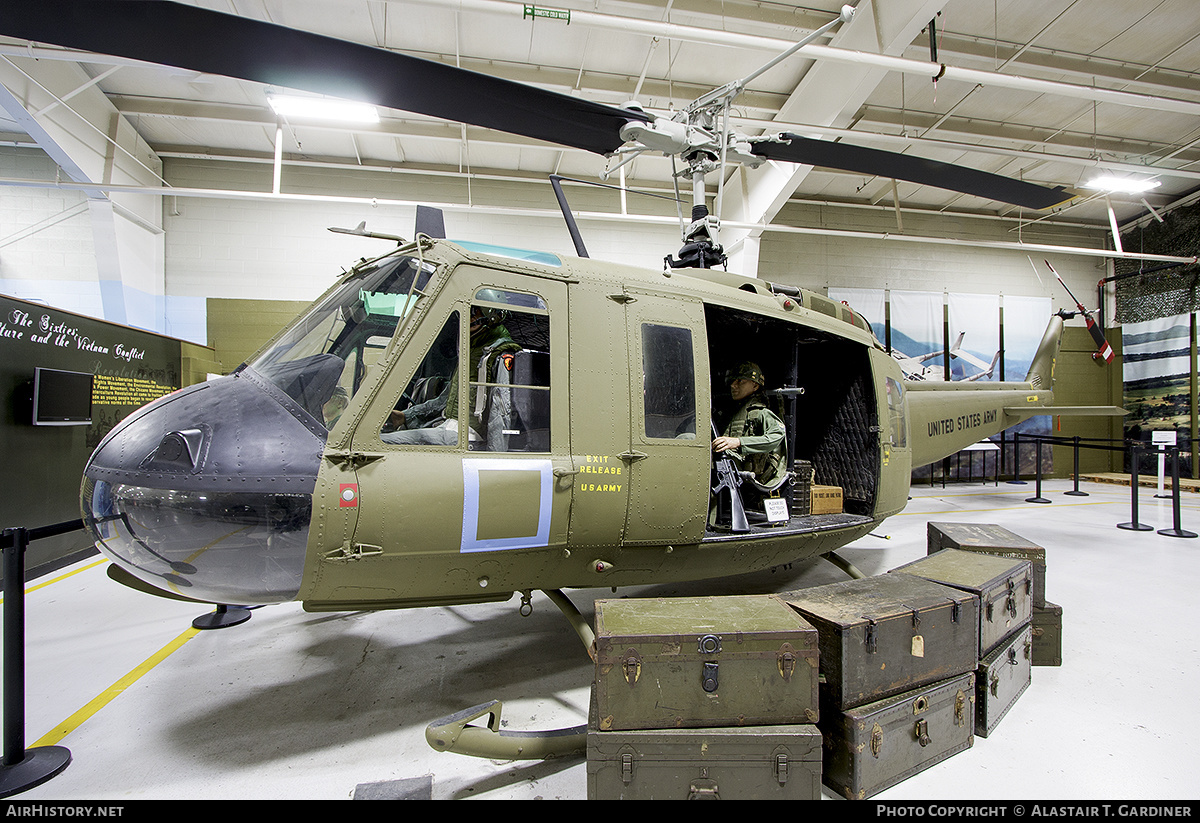
The extraordinary journey of Huey 66-16006—from the Sierra Nevada to Vietnam and back into the sky.
Introduction
I have been an Army aviation groupie since I was a kid in high school. By the time I was seventeen and living in Bishop, California, I was already thoroughly hooked. Edwards Air Force Base, the aircraft, the test pilots, the helicopters working the high country around Bishop, Coyote Flats, and the White Mountains—all of it fed a fascination that had started years earlier.
And what a time and place to be fascinated by aviation.
Mercury and Gemini had captured my imagination. Chuck Yeager and the test pilots at Edwards were pushing the boundaries of flight. Aircraft were constantly being tested, modified, evaluated, and prepared for missions around the world. The Army and Air Force were both active in the region, and the mountains around Bishop provided a demanding laboratory for high-altitude helicopter testing.
I watched. I listened, I paid attention. I wanted to know what those aircraft were doing and why. I never imagined that Army aviation would eventually become part of my own life.
It did.
I served in Army aviation as a flight simulator specialist and later as an air traffic controller. Along the way came marriage, raising a family, finishing college, graduate school, and eventually a second career as a therapist specializing in post-traumatic stress. Today I am retired, although I continue to work part-time with Vietnam veterans still living with the effects of their sacrifice.
So, when I came across the history of Bell UH-1H 66-16006, her story caught my attention in a way another aircraft history might not have. Her story begins in the very California Sierra-high country that had fascinated me as a teenager. Before she became a Gladiator of the 57th Assault Helicopter Company, she was an Army test aircraft, helping explore the limits of helicopter performance at high altitude.
Then she went to Vietnam. She became a Gladiator. She was damaged in combat, rebuilt, and returned to service. After Vietnam, she continued working in a succession of military and federal roles before eventually becoming a museum aircraft.
And then, remarkably, she returned to the sky.
Her history spans much of the world of aviation that has occupied my imagination for most of my life. This is the story of 66-16006. It is also a small piece of the story of how Army aviation has evolved from a kid watching aircraft in the sky to serving in the Army to spending a career tending to people who came home carrying the invisible consequences of war.
Some stories take a straight line. This one didn’t. Neither did mine.
Bishop, Edwards, and a Seventeen-Year-Old’s Imagination
In 1968, I was seventeen years old and living in Bishop, California. I was what you might politely call an Army aviation groupie, and I was living in a pretty remarkable place to feed that particular obsession. Edwards Air Force Base was roughly 160 miles south of Bishop, but its presence seemed much closer when you were seventeen and fascinated by anything that flew.
Edwards was already legendary. In 1947, Chuck Yeager flew the Bell X-1 through the sound barrier there, and the test programs that followed continued to push the boundaries of aviation. By the time I was a teenager, Edwards had become synonymous with experimental aircraft, test pilots, engineers, and the question that seemed to drive all of them: What can this machine do?
And then there was the space program. Mercury and Gemini had completely captured my imagination. Americans were climbing into tiny spacecraft and being hurled into orbit, and the whole country seemed to be looking upward. I was too.
But while Mercury and Gemini sent my imagination into space, the aviation activity around Bishop kept my feet firmly planted on the ground. The Owens Valley and the mountains surrounding it were not simply beautiful scenery. Coyote Flats and the White Mountains provided challenging high-altitude terrain where Army helicopters could be tested under conditions that could not be duplicated on a flat runway.
The Army was evaluating helicopters, engines, modifications, and configurations under demanding conditions—thin air, high elevations, steep terrain, mountain winds, and the reduced performance that comes with altitude. Much of that work had practical implications for aircraft and crews eventually headed to Vietnam.
And it wasn’t just the Army. The Air Force had an enormous presence in the broader flight-test world surrounding Edwards. Aircraft came and went. Test programs were underway. The mountains around Bishop became part of a much larger military aviation laboratory.
For a seventeen-year-old kid fascinated by aviation, it was intoxicating.
I wasn’t part of any of it. I wasn’t a test pilot or an engineer. I wasn’t standing on White Mountain watching the Army work through a flight envelope. I was simply paying attention.
I had no idea then that one of the Hueys involved in that testing would eventually become Bell UH-1H 66-16006—a Gladiator of the 57th Assault Helicopter Company. Looking back, I realize I was living in the middle of an extraordinary chapter of American aviation history.
I just didn’t know then that I was.
From Bell Helicopter to the High Country
Her story began in February 1967, when the U.S. Army accepted 66-16006 from Bell Helicopter’s assembly facility in Fort Worth, Texas. Built as a UH-1D Iroquois, construction number 5700, she initially appeared destined for the Army’s growing fleet of operational Hueys.
But this particular Huey took a different route. Rather than going directly to an operational unit, she was loaned back to Bell Helicopter for engineering work. Between August and October 1967, she became an engineering testbed for the installation of the more powerful Lycoming T53-L-13 engine, rated at 1,400 shaft horsepower. The modification transformed her from the original D-model into the UH-1H configuration that would become so familiar during the Vietnam War.
Her developmental work continued with the U.S. Army Aviation Engineering Flight Activity (USAAEFA), operating from Edwards Air Force Base. And this is where her story crosses the landscape of my youth. In early 1968, 66-16006 conducted high-altitude flight testing in the Bishop area, including Coyote Flats and the White Mountains.
The engineers weren’t simply interested in whether she could fly. They wanted to know where her limits were.
At high altitude, everything changes. Air density decreases. Engine performance is affected. Rotor performance changes. Hovering becomes more demanding. A helicopter that performs comfortably at sea level can find herself with very little margin at elevation.
Those were precisely the conditions that made the Owens Valley and surrounding mountains such valuable testing grounds. And according to her reported history, one flight near White Mountain Peak became particularly significant.
The White Mountain Incident
The damage was severe. Her tail gearbox was heavily damaged, and the incident resulted in personnel casualties. Early records reportedly classified her as a write-off.
While conducting out-of-ground-effect hover testing near White Mountain Peak, 66-16006 encountered severe power settling in combination with a mountain downdraft. She could not sustain the hover in the thin mountain air. The test pilot was faced with a choice that left little room for error.
The recovery involved a steep dive into the canyon below, trading altitude for forward airspeed and allowing her to regain translational lift and escape the vortex-ring condition.
She survived. More importantly, the flight produced valuable engineering information about the limits of helicopter performance at altitude. The lessons learned from this kind of testing became part of the body of knowledge used to establish helicopter operating limitations and the height-velocity information familiar to generations of pilots.
But numbers on a clipboard tell only half the story. To a seventeen-year-old watching the drama ripple across the tarmac at Bishop Airport, the reality was far more visceral. It wasn’t a calculated textbook maneuver; it was pure survival instinct and masterful piloting. When the aircraft lost lift in that thin, unforgiving air, the pilot in command didn’t crash—he fought for every inch of sky. By deliberately taking a nose dive down over the cliff face, he used gravity as a last-resort trade, forcing air back up through the rotors to recover his RPM and fly the ship away cleanly.
When the crew finally set her back down on the Bishop ramp, the collective relief was palpable. All were amazed. The sheer adrenaline of staring down a canyon wall and escaping it demanded an outlet. That evening, the technical thresholds of the T53-L-13 engine were forgotten, replaced by the ancient military tradition of laughing in the face of disaster. Gathered around a motel pool, drinking lots of beer, the crew members and pilots broke out a guitar and took Buck Owens’ hit country song, “Act Naturally,” and turned it into a parody anthem for the test detachment. They sang away into the night, mocking their own brush with fate as the “biggest fools that ever hit White Mountain,” joking that all they had to do to survive was fly naturally.
The young woman living in Bishop at the time knew none of those technical details. I simply knew that Army aviation was doing remarkable things in those mountains. And somewhere in that world was 66-16006.
Becoming a Gladiator
In April 1968, she left her experimental work behind and entered the operational fleet. Her next destination was the Republic of Vietnam.
There, 66-16006 joined the 57th Assault Helicopter Company—the Gladiators. The Huey that had spent months helping Army engineers explore the limits of high-altitude flight was now doing the work for which the UH-1 had become famous: carrying soldiers, crews, equipment, and supplies into the demanding environment of war. From bases including Kontum and Camp Holloway near Pleiku, she served as a troop-transporting slick under the company call sign Gladiator.
Whatever her earlier life as an engineering test aircraft, none of that mattered much when a crew climbed aboard and a mission was waiting. What mattered was whether she would perform.
And 66-16006 would be tested again.
During a command-and-control mission, while operating at a true altitude of 9,000 feet, 66-16006 was struck in the tail section by a reported 14.5mm anti-aircraft projectile.
(Note: While some standardized military database logs dryly record this combat orbit at “0900” feet, those of us who watched these machines push the altitude limits back home recognize the familiar shorthand. Orbiting at 9,000 feet kept the C&C ship well clear of standard infantry small-arms fire while maintaining a clean line-of-sight for radio relays across the jungle canopy. However, it put them directly in the crosshairs of heavy, Soviet-designed 14.5mm anti-aircraft guns, whose vertical reach extended far into the clouds.)
But she wasn’t finished. She was recovered and sent through depot-level maintenance, where maintenance personnel undertook the work necessary to rebuild and restore her to flying condition. And then she went back to work with the Gladiators.
There is something fitting about that part of her story. She had already been pushed to her limits in the mountains of California. Now she had been damaged in combat, declared lost, rebuilt, and returned to the same company she had been serving.
Aircraft don’t put themselves back together. People do. Pilots. Crew chiefs. Mechanics. Recovery crews. Depot personnel. All the people whose names may never appear in the aircraft’s official history but whose hands are all over it.
The survival of 66-16006 belongs to them, too.
A Life After Vietnam
When 66-16006 left Vietnam in February 1971, her military career was nowhere near finished. Over the next fifteen years, she accumulated a remarkable assortment of assignments.
Her reported postwar history includes a temporary loan to the University of Michigan for engineering research, service in West Germany as an aeromedical air ambulance, temporary operational support to NASA, and deployment to Central America in connection with security duties surrounding the Panama Canal. Eventually, she returned to the United States and served with the Illinois Army National Guard, supporting domestic training operations.
In 1986, nearly twenty years after the Army first accepted her, 66-16006 finally retired from military service. Most military aircraft would have ended their stories there. She didn’t.
The Museum Years
Following military retirement, 66-16006 became part of the Yankee Air Museum collection at Willow Run Airport in Michigan. For more than thirty years, she stood as a static exhibit.
The Huey that had once been a test aircraft, a combat slick, an ambulance, a support aircraft, and a National Guard trainer became a piece of history for museum visitors to see rather than hear.
But in 2019, her story took another unexpected turn. Northwest Helicopters acquired her for restoration. On October 1, 2019, the Federal Aviation Administration issued her civilian registration as N876GM. After extensive mechanical, structural, and engine work, 66-16006 was returned to airworthy condition.
The old Girl was Flying Again.
Coming Full Circle. There is something wonderfully improbable about that.
A helicopter accepted by the Army in 1967 became an experimental test aircraft. She helped push the limits of high-altitude flight in the mountains near the town where I was living as a teenager. Then she went to Vietnam. She became a Gladiator. She was shot up, rebuilt, and returned to combat service. She traveled the world. She became a museum exhibit. And then, more than fifty years after leaving the Bell factory, she returned to the sky.
I was seventeen years old in Bishop when the first chapters of this story were unfolding. At the time, I was busy being fascinated by Army aviation, watching aircraft come and go, following the space program, and letting my imagination run wild with Mercury and Gemini.
I didn’t know the serial numbers. I didn’t know the engineering reports. I didn’t know which aircraft would become part of which company. I certainly didn’t know that one of those Hueys would eventually become part of the history of the 57th Assault Helicopter Company.
I just watched. I paid attention. And apparently, somewhere along the way, I remembered.
Now, nearly sixty years later, I find myself looking at the history of 66-16006 with something approaching wonder. Not simply because she survived. But because her story connects so many pieces of a world that shaped me: Bishop and the White Mountains, Edwards and its test pilots, the extraordinary years of Mercury and Gemini, the Army aviation community, Vietnam, and finally the men of the 57th AHC.
She has changed names and registrations along the way. But the lineage remains. 66-16006 was once a Bell test aircraft. She became an Army Huey. She became a Gladiator. Today she flies as N876GM.
For those of us who care about the history of the 57th Assault Helicopter Company, she remains something more than an old helicopter. She is a living piece of the story. And perhaps that’s the best kind of history there is—the kind that refuses to stay still.
Once a Gladiator, always a Gladiator.
Sources:
57th Assault Helicopter Company. (n.d.).
U.S. Army Gold Book master log: Operational flight history of UH-1H 66-16006.
Vietnam Helicopter Records Archive. http://57thahc.com
Leave a Reply